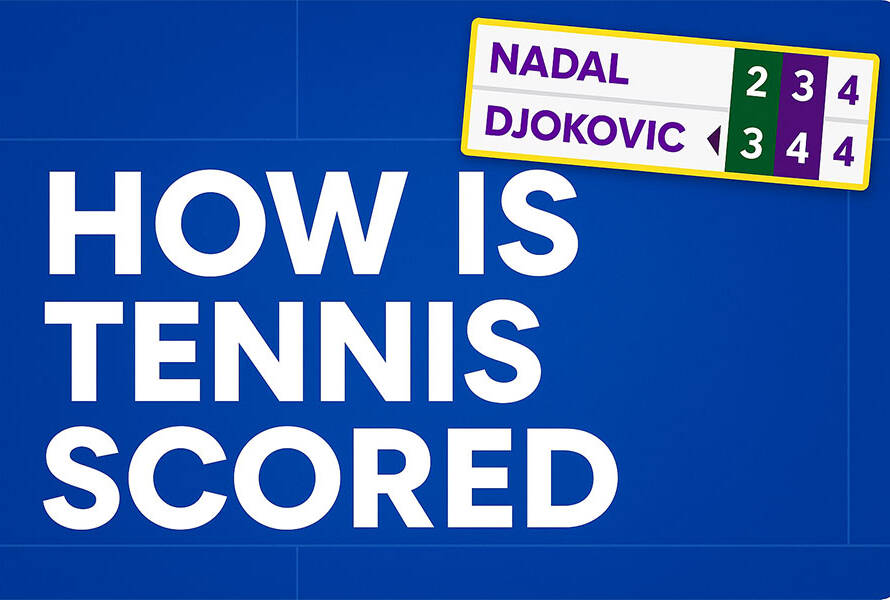
The basic rules of tennis form the foundation of how the game is played at every level, from casual backyard matches to professional tournaments. The main objective of tennis is to hit the ball over the net and into the opponent’s court so that it cannot be returned legally. A point ends when one player breaks the tennis rules by hitting the ball out of bounds, into the net without crossing, or allowing the ball to bounce more than once.
According to the rules of tennis, players may only strike the ball with their racket, and catching, carrying, or throwing the ball is not allowed. The racket is considered part of the player’s body, so any contact with the racket counts as a legal hit. A ball that touches any line on the court is considered in, which is an important rule beginners often misunderstand.
These basic tennis rules apply equally in singles and doubles matches. Learning them is essential for tennis rules for beginners, because every other rule — including serve rules, scoring rules, and match rules — builds on these fundamentals. Without understanding the basics, it becomes difficult to follow rallies or understand how points are actually won.
How Is Tennis Played According to Official Rules?
To understand how tennis is played, it is important to follow the flow of a point from start to finish. A tennis point always begins with a serve. After the serve, players engage in a rally by hitting the ball back and forth over the net. The rally continues until one player wins the point by following the tennis rules correctly while the opponent makes a mistake.
Players must hit the ball into the opponent’s side of the court and allow only one bounce before returning it. According to tennis court rules, players are allowed to hit the ball from anywhere, even outside the court, as long as the ball lands inside the correct boundaries. This surprises many beginners but is a standard rule in tennis.
Tennis can be played as singles or doubles, but the way tennis is played remains largely the same. The court size changes slightly, yet the tennis game rules governing rallies, legal shots, and point endings stay consistent. Understanding how tennis is played helps beginners follow professional matches and play with confidence.
Tennis Serve Rules Explained
The serve is one of the most important shots in tennis, which is why tennis serve rules are strict and carefully enforced. Every point starts with a serve, and if the serve does not follow the rules of tennis, the point can be lost immediately.
According to tennis serve rules, the server must stand behind the baseline and hit the ball diagonally into the opposite service box. The server is allowed two attempts to get the serve in. If the first serve is missed, a second serve is allowed. If both serves are missed, a double fault occurs and the server loses the point.
A common mistake among beginners is stepping on or over the baseline before hitting the serve. This is known as a foot fault and counts as a serving error. Tennis serve rules apply in both singles and doubles matches, although the serving order changes in doubles. Learning serve rules early helps tennis rules beginners avoid unnecessary point losses.
Tennis Match Rules: How a Match Is Won
The tennis match rules explain how individual points turn into games, sets, and ultimately a match victory. A tennis match is not won by scoring a single point or game. Instead, players must win games to win sets and win sets to win the match.
Most tennis matches are played as best of three sets, meaning a player must win two sets to win the match. In some professional tournaments like Grand Slam in Tennis, matches are played as best of five sets, requiring three set wins. According to tennis rules, a player must win a set by at least two games.
If a set reaches six games all, a tiebreak is usually played to decide the set winner. These tennis match rules ensure fairness and consistency across competitions. For beginners, understanding how a match is won helps make sense of match length and key moments during play.
Tennis Court Rules and Line Boundaries Explained
Tennis court rules define how the playing area is used and where the ball is allowed to land. The tennis court is divided into two equal halves by the net and marked with clear boundary lines. Singles matches use the narrower inner sidelines, while doubles matches use the wider outer sidelines.
According to the rules of tennis, any ball that touches a line is considered in. This rule often causes confusion for beginners, but it is essential for fair play. Service boxes are used only during serves, while the full court is used during rallies.
Tennis court rules also allow players to hit the ball from outside the court as long as the ball lands inside the boundaries. Understanding court lines and boundaries is crucial for applying tennis rules correctly and avoiding disputes during matches.
Tennis Net Rules: What Is Allowed and What Is Not
The tennis net rules are designed to maintain fairness, safety, and clear boundaries during play. According to the rules of tennis, players are not allowed to touch the net with any part of their body, clothing, or racket while a point is in progress. If a player touches the net before the point ends, they automatically lose the point, regardless of where the ball lands.
Players are also not allowed to cross over to the opponent’s side of the net before the ball has bounced on their own side. Reaching over the net to hit the ball is only allowed if the ball has already bounced back over due to spin. This is a subtle but important part of tennis net rules that beginners often misunderstand.
If the ball hits the net during a rally and still lands inside the opponent’s court, play continues normally. However, if the ball hits the net and does not cross over, the point ends immediately. These tennis rules ensure that net play remains fair while still allowing exciting rallies close to the net.
Tennis Rules for Singles Matches
Tennis rules singles matches involve one player competing against another, with each player responsible for covering the entire court. Singles matches use the narrower court, meaning the doubles sidelines are not in play. Despite the smaller court width, singles tennis demands high levels of movement, endurance, and tactical awareness.
All standard tennis rules apply in singles matches, including serve rules, scoring rules, and court rules. The server alternates every game, and players must follow the same service box and baseline regulations as in doubles. The difference lies mainly in positioning and strategy rather than rule changes.
For beginners learning tennis rules, singles matches are often easier to understand because there is no need to coordinate with a partner. Understanding tennis rules singles play helps players focus on fundamentals such as shot placement, footwork, and consistency while still following the official rules of tennis.
Tennis Rules for Doubles Matches
Tennis rules doubles matches involve two players on each side of the court, making teamwork and coordination essential. Doubles matches use the wider court, including the doubles sidelines, which allows for more angles and strategic play. Although the court size changes, the core tennis rules remain the same as in singles.
One important difference in doubles tennis rules is the serving order. Each team must follow a fixed rotation, with partners alternating serves every service game. This order must be maintained throughout the set. Both players on a team are allowed to hit the ball, and communication between partners is permitted.
Doubles tennis often involves more net play and faster points, but tennis net rules, serve rules, and scoring rules still apply. For tennis rules beginners, understanding doubles rules helps avoid confusion about court boundaries and serving rotation.
What Is a Fault in Tennis?
A fault in tennis occurs when a serve does not meet the requirements set by tennis serve rules. Common faults include serving the ball outside the correct service box, hitting the net and failing to land the ball in, or committing a foot fault by stepping on or over the baseline during the serve.
According to tennis rules, a player is allowed two attempts to serve the ball correctly. If the first serve is a fault, the player may attempt a second serve. If the second serve is also a fault, this results in a double fault, and the server automatically loses the point.
Faults apply only to serves, not rallies. Understanding what constitutes a fault is essential for tennis rules for beginners, as many points are lost unnecessarily due to serving mistakes rather than rally errors.
What Is a Let in Tennis?
A let in tennis occurs when the serve touches the net but still lands correctly in the opponent’s service box. When this happens, the serve is replayed without penalty. According to tennis rules, lets apply only to serves and not to rally shots.
Lets are important because they prevent players from losing points due to minor net contact that does not affect fairness. A serve can be called a let multiple times in a row, and the server continues serving until a legal serve is made or a fault occurs.
For beginners, the concept of a let can be confusing, but it is a simple rule designed to ensure fair play. Understanding what a let is helps players follow tennis serve rules correctly and avoid disputes during matches.
What Happens If the Ball Hits the Net in Tennis?
One of the most common beginner questions about tennis rules is what happens when the ball hits the net. The answer depends on when and how the ball touches the net. According to the rules of tennis, if the ball hits the net during a rally and still lands inside the opponent’s court, the point continues as normal. Net contact during a rally does not stop play unless the ball fails to cross the net.
However, if the ball hits the net and does not cross to the opponent’s side, the point ends immediately, and the player who hit the ball loses the point. These tennis net rules apply in both singles and doubles matches and help maintain fairness during rallies.
Net contact is treated differently during serves. If a serve hits the net but still lands correctly in the service box, it is called a let and the serve is replayed. Understanding what happens when the ball hits the net helps tennis rules beginners avoid confusion and recognize legal versus illegal shots during matches.
How Many Games and Sets Are Played in Tennis?
Understanding how many games in tennis make up a match is essential for following the structure of the sport. According to tennis match rules, a standard set is won by the first player to win six games with a lead of at least two games. Common set scores include 6–3, 6–4, and 7–5.
Most tennis matches are played as best of three sets, meaning a player must win two sets to win the match. Some professional matches, particularly at higher levels, use a best-of-five format. These tennis rules apply consistently across most competitions.
If a set reaches six games all, a tiebreak is usually played to decide the set winner. Knowing how many games and sets are played in tennis helps beginners understand match length, momentum shifts, and when a match is nearing its conclusion.
Tennis Tiebreak Rules Explained Simply
Tennis tiebreak rules are used to prevent sets from continuing indefinitely. A tiebreak is played when the score in a set reaches 6–6. Instead of continuing until a two-game lead is achieved, the tiebreak decides the set winner in a structured way.
In a tiebreak, points are counted numerically rather than using traditional tennis scoring terms. The first player to reach seven points with a two-point advantage wins the tiebreak and the set. Players alternate serves during the tiebreak according to official tennis rules.
Tiebreaks also include scheduled changeovers, where players switch ends after a certain number of points. These rules ensure fairness and balance. Understanding tennis tiebreak rules is important for beginners because tiebreaks often decide close and competitive matches.
Serving Order Rules in Tennis Matches
Serving order is an important part of tennis rules, especially in doubles matches. In singles tennis, the serving order is simple: players alternate serving every game throughout the match. This rotation continues regardless of set changes or tiebreaks.
In doubles tennis, serving order rules are more structured. Each team chooses which player will serve first at the start of a set. After that, players follow a fixed rotation, with each player serving one game in turn. This order must be maintained for the entire set.
Serving order rules ensure fairness and consistency. Changing the serving order during a set is not allowed. For tennis rules beginners, understanding serving order helps avoid penalties and confusion, especially in doubles matches where coordination between partners is required.
Change of Ends Rules in Tennis
The change of ends rules in tennis exist to balance court conditions such as sun, wind, and surface wear. According to the rules of tennis, players change ends after the first game of a set and then after every odd-numbered game.
During tiebreaks, players change ends after every six points. This ensures that neither player has an unfair advantage due to environmental factors. These tennis rules apply in singles and doubles matches.
Changeovers are also used as brief rest periods. Players may sit down and hydrate, but coaching restrictions still apply depending on the competition. Understanding change of ends rules helps beginners follow match flow and recognize official break moments during play.
Time Violations and Delay Rules in Tennis
Time management is an important part of tennis rules, especially at competitive levels. To keep matches fair and moving smoothly, official rules of tennis include strict time limits between points, games, and sets. Players are generally required to serve within a specific time after the previous point ends. Exceeding this time limit can result in a time violation.
According to tennis match rules, the first time violation usually results in a warning. If a player continues to delay play, further violations can lead to point penalties or even game penalties. These rules apply to both singles and doubles matches and are enforced more strictly in professional tournaments.
Delay rules also cover unnecessary interruptions such as excessive towel use, slow walking between points, or extended discussions with officials. For tennis rules beginners, these rules highlight the importance of maintaining a steady pace during play. Time violation rules exist to ensure fairness for both players and to keep matches enjoyable for spectators.
Code Violations and Penalties in Tennis
The code of conduct is a key part of tennis rules that governs player behavior on the court. Code violations occur when a player behaves in an unsportsmanlike manner, such as using audible profanity, abusing equipment, or arguing excessively with officials.
Under tennis rules, penalties for code violations follow a progressive system. The first violation usually results in a warning. A second violation may lead to a point penalty, followed by a game penalty if the behavior continues. In severe cases, a player can be defaulted from the match.
These rules apply equally in singles and doubles matches. Code violations exist to protect the integrity of the sport and ensure respectful competition. Understanding these rules helps beginners recognize acceptable behavior and understand penalties they may see during professional matches.
Equipment Rules in Tennis
Equipment rules in tennis ensure that all players compete under fair and standardized conditions. Tennis rackets must meet specific size and material requirements set by governing bodies. Using an illegal racket violates tennis rules and can result in penalties.
Tennis balls must also meet approved standards for size, weight, and bounce. Balls are changed at regular intervals during matches to maintain consistency. Clothing rules generally allow freedom of movement, but some tournaments may enforce dress codes.
For tennis rules beginners, understanding equipment rules helps avoid unintentional violations. Using approved rackets, balls, and proper attire ensures fair play and compliance with official tennis rules at all levels of the sport.
On-Court Coaching and Communication Rules
On-court coaching rules are an important part of modern tennis rules. Traditionally, coaching during matches was prohibited, meaning players had to rely solely on their own decision-making. However, some tournaments now allow limited coaching under specific conditions.
According to tennis rules, coaching may be permitted during changeovers or set breaks, depending on the competition. In many events, verbal coaching during points is still not allowed. Doubles matches often allow more communication between partners, but outside coaching remains restricted.
These rules exist to maintain fairness and ensure that matches are decided by player skill rather than external assistance. For beginners watching professional tennis, understanding coaching rules explains why players sometimes receive advice and other times are penalized for it.
Common Tennis Rules Beginners Often Misunderstand
Many beginners struggle with certain tennis rules because they are not always obvious. One common misunderstanding is believing the ball must land fully inside the court. In reality, a ball touching the line is considered in according to tennis court rules.
Another confusion involves net contact. Beginners often think any ball touching the net is illegal, but during rallies, net contact is allowed if the ball crosses successfully. Serving rules such as lets and foot faults are also frequently misunderstood.
Understanding these commonly misinterpreted tennis rules helps beginners avoid frustration and enjoy the game more confidently. Learning the details early makes both playing and watching tennis far more enjoyable.
Tennis Scoring Rules Explained
Tennis scoring is one of the most unique parts of the game and often the most confusing for beginners. While understanding basic tennis rules is important, learning how points, games, and sets are calculated gives you a much deeper understanding of how tennis matches are decided. This article briefly explains the tennis scoring rules so you can follow matches more easily. However, if you want a full breakdown of the tennis scoring system, including deuce, advantage, tiebreaks, and real match examples, be sure to read our complete guide on tennis scoring explained, where everything is covered in detail step by step.