How Tennis Scoring Works, Rules, Sets, Games, and Tie-Breaks
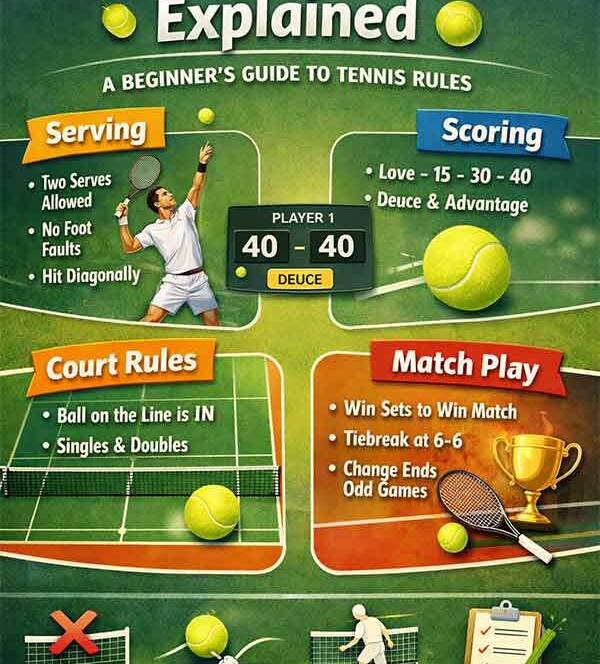
The tennis scoring system is one of the most unique parts of the sport. Many beginners find tennis confusing at first because the score does not follow normal numbers like 1, 2, 3, or 4. Instead, tennis uses terms such as 15, 30, 40, deuce, advantage, and tie-break.
If you have ever asked questions like how does tennis scoring work, how is tennis scored, or how to keep score in tennis, this guide is for you. This article explains tennis scoring rules step by step, using simple language so anyone can understand how tennis matches are scored.
For a complete understanding of the game, visit our Tennis Rules Blog where 20 tennis rules are explained in detail.
How Does Tennis Scoring Work?
To understand how tennis scoring works, you need to know that tennis is scored in layers. A tennis match is not decided by one single score. Instead, it is built using points, games, sets, and matches.
Here is the basic structure:
-
Points make up a game
-
Games make up a set
-
Sets make up a match
A player must win points to win a game, win games to win a set, and win sets to win the match. This layered structure is the foundation of the tennis scoring system and explains why even one point can be important.
Because of this system, tennis matches can change quickly. One break of serve or one tie-break can completely change the result of a match.

Tennis Scoring System Explained
The tennis scoring system is based on tradition and has been used for hundreds of years. Unlike most sports, tennis does not use regular numbers for points.
In tennis:
-
The score starts at love (zero)
-
Points are counted as 15, 30, and 40
-
A player must win by two points
This system applies to every game in a match. Understanding this structure makes it much easier to follow professional matches and to know how to score tennis correctly when playing yourself.
The goal of the tennis scoring system is to create tension and fairness, ensuring that players must clearly outperform their opponent to win.
Points in Tennis: 15, 30, 40, Deuce, and Advantage
The tennis point system is often the most confusing part for beginners. Instead of counting points as 1, 2, 3, tennis uses the following system:
-
0 points = Love
-
1 point = 15
-
2 points = 30
-
3 points = 40
If a player wins a fourth point and is ahead by two points, they win the game. However, if both players reach 40, the score becomes deuce, and the game continues until one player wins two points in a row.
This system ensures that games are competitive and cannot be won by luck alone.
What Is Deuce in Tennis?
Deuce in tennis happens when both players reach 40–40. At deuce, the game does not end. Instead, one player must win two consecutive points to win the game.
Deuce situations are common in tennis, especially when players are evenly matched. A game can go to deuce multiple times, making it longer and more exciting.
Knowing the tennis score after deuce is important for understanding how pressure builds during key moments.
What Does Advantage (Ad) Mean in Tennis?
After deuce, the next point gives a player advantage, often called Ad.
-
Ad-In means the server has advantage
-
Ad-Out means the receiver has advantage
If the player with advantage wins the next point, they win the game. If they lose the point, the score returns to deuce.
This back-and-forth between deuce and advantage is a key feature of tennis scoring rules.
How Many Sets Are Played in Tennis?
A very common question is how many sets in tennis or how many sets in a tennis match. The answer depends on the tournament and level of play.
Most tennis matches are played as best-of-three sets, meaning:
-
The first player to win two sets wins the match
In men’s Grand Slam matches, matches are played as best-of-five sets, meaning:
-
The first player to win three sets wins the match
So, when asking how many sets to win in tennis, the answer is usually two or three, depending on the format.
How Many Games Are in a Set of Tennis?
Another important part of how to keep score in tennis is understanding sets and games.
A standard set in tennis is won when a player:
-
Wins six games
-
Leads by at least two games
Common set scores include:
-
6–2
-
6–4
-
7–5
If the score reaches 6–6, a tie-break is usually played to decide the set.
This answers the common question how many games in a set of tennis.
Tie-Break Rules in Tennis
Tennis tie-break rules are used to prevent sets from going on forever. A tie-break is played when the score in a set reaches 6–6.
In a tie-break:
-
Points are counted as 1, 2, 3, 4, not 15, 30, 40
-
The first player to reach 7 points
-
Must win by 2 points
The winner of the tie-break wins the set 7–6. Understanding tiebreaker rules in tennis is essential because tie-breaks often decide important matches.
Common Tennis Scoring Terms
Tennis uses many special terms that describe important moments in a match. Learning these terms makes it much easier to follow matches and understand commentary.

What Is a Break Point in Tennis?
A break point in tennis occurs when the receiving player is one point away from winning the game on the opponent’s serve.
Break points are crucial because serving is usually an advantage. Winning a break point often changes the momentum of a match.
What Is a Set Point in Tennis?
A set point is when a player is one point away from winning a set. If the player wins that point, the set is over.
Set points often occur at scores like 5–4 or during tie-breaks and are very high-pressure moments.
What Is a Match Point in Tennis?
A match point happens when a player is one point away from winning the entire match. Winning a match point ends the contest immediately.
Match points are some of the most dramatic moments in tennis because everything depends on one point.
How to Keep Score in Tennis During a Match
Many beginners ask how to keep score in tennis, especially when watching a live match or playing for the first time. Keeping score in tennis becomes easy once you understand how points, games, and sets connect.
When keeping score, always remember:
-
Points are called out first (15, 30, 40)
-
Games won are tracked within a set
-
Sets won are tracked within the match
For example, if the score is announced as 30–15, this refers to the current game only. If the score is 4–2, this refers to games within the current set. If a player leads 1–0 in sets, it means they have already won one full set.
Learning how to keep score in tennis is especially useful when playing recreational matches, where there may be no official scorekeeper. One player usually calls out the score before each serve to avoid confusion.
How Many Games Are in a Tennis Match?
Another common question related to tennis scoring is how many games in a tennis match. The answer depends on how many sets are played and how close the match is.
In a best-of-three sets match:
-
Each set usually has at least 6 games
-
A match often has 18–30 games, sometimes more
In a best-of-five sets match:
-
The total number of games can be much higher
-
Long matches may exceed 40 or 50 games
Because of tie-breaks, deuce games, and close sets, there is no fixed number of games in a tennis match. This unpredictability is part of what makes tennis exciting.
Tennis Scoring Rules in Different Formats
While the traditional tennis scoring rules apply to most matches, some formats use slight variations.
Examples include:
-
No-ad scoring: At deuce, the next point wins the game
-
Super tie-breaks: Used instead of a final set in some matches
-
Short sets: Sets played to 4 games instead of 6
Even with these variations, the basic tennis scoring system remains the same. Understanding the standard rules first makes it easy to adapt to these formats.
Why Tennis Scoring Is Designed This Way
Many people wonder why tennis uses such a unique scoring system. The reason is tradition, but also balance. The tennis scoring system is designed to:
-
Reward consistency
-
Create pressure at key moments
-
Prevent matches from ending too quickly
Terms like break point, set point, and match point exist to highlight the importance of specific points. These moments add drama and make tennis exciting to watch.
Common Mistakes Beginners Make with Tennis Scoring
When learning how tennis scoring works, beginners often make a few common mistakes:
-
Forgetting to win by two points
-
Confusing game scores with set scores
-
Misunderstanding deuce and advantage
-
Losing track during long tie-breaks
These mistakes disappear quickly with practice. Watching professional matches and calling out the score while playing helps reinforce the tennis scoring rules.
Tennis Scoring Explained for Beginners
Once you fully understand tennis scoring explained step by step, the sport becomes much easier to follow. The unusual numbers, special terms, and layered structure all work together to create fair and competitive matches.
By learning:
-
The tennis point system
-
How many sets in tennis
-
How many games in a set of tennis
-
Tie-break rules in tennis
-
What deuce, advantage, break point, set point, and match point mean
you gain a complete understanding of how tennis is scored from start to finish.
Final Thoughts on Tennis Scoring
The tennis scoring system may seem confusing at first, but once you understand the basics, it becomes logical and exciting. Knowing how tennis scoring works, how points, games, sets, and tie-breaks are counted, and what key terms mean allows you to enjoy tennis much more.
This guide explained:
-
Tennis scoring rules
-
Tennis point system
-
How many sets in tennis
-
How many games in a set of tennis
-
Tie-break rules in tennis
-
Important scoring terms like break point, set point, and match point
With this knowledge, you now know how to score tennis correctly and follow matches with confidence.